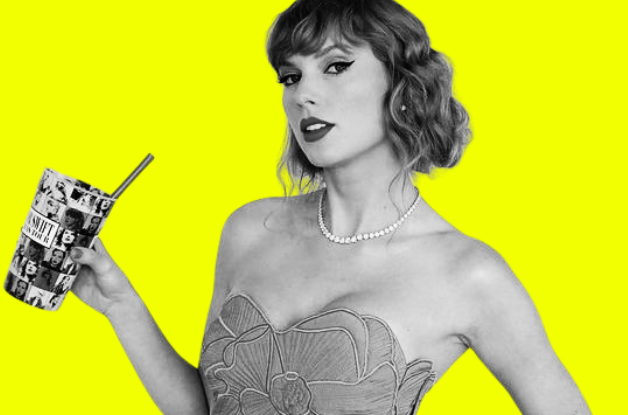
How Taylor Swift Became a Billionaire by Marketing Her Eras
In This Post
Taylor Swift isn’t just a music icon — she’s a marketing powerhouse. Her decades-long career is defined by distinct “eras,” each with its own visual aesthetic, merch, and narrative that fans obsessively decode. This post digs into how Swift engineered her own brand architecture, merged fandom with commerce, and built a billion-dollar empire from diary entries, Easter eggs, and red lipsticks.
In other words, this is a post about Taylor Swift marketing as much as Taylor Swift music: how a 20-year career became a series of carefully branded eras, and how fans turned that structure into free advertising, research and amplification for a billion-dollar brand.
If you’ve ever wondered what it looks like when long-term brand building and short-term social media campaigns actually work together, Swift is the textbook case.
Taylor Swift is a singer, songwriter and self-marketing genius. With a career spanning 20 years, Swift is the most popular female pop star on the planet today.
She’s a “postmedia celebrity” and “digital native,” New York Times journalist Taffy Brodesser-Akner wrote in a long profile on Swift’s Eras tour.
The profile is not like a usual celebrity deep-dive. Brodesser-Akner does not quote Swift at all. This is because she could not interview Swift for the article.
When Brodesser-Akner contacted Swift’s PR team for an interview, the publicist said Swift was too busy to participate.
Brodesser-Akner emphasizes that Taylor didn’t need to talk to her. She felt that using a middle man would waste her time. Swift has nearly half a billion followers on all her social media. In comparison, the New York Times has only 92 million.
“Whether you like Taylor Swift as a person or not, she is a marketing genius,” said ASA designer/Swift-expert, Stella Green-Rhoades.
And it’s true: Swift, like Kim Kardashian, has faced a lot of hate for many reasons. Yet, like Kim, she is a billionaire. She has a clear talent for turning her creativity into success.
Taylor Swift has used personal branding in the digital age to achieve billionaire status. To understand Swift’s marketing strategy, we need to look at her relationship with fans, her social media presence and her “Eras”.
The Swifties department
“A Swiftie is a higher level than a fan,” Green-Rhoades said. “Cultish” might be a strong word, but Taylor’s Swifties are a large group of fans. They feel a strong bond with Swift’s personal story through her music, and her music connects with them too.
Few fan bases embody the passion, force and impact of Taylor’s Swifties. A lyric in a song from Swift’s album Midnights inspired a friendship-bracelet trading frenzy at shows on her Eras tour.
Swifties play word puzzles and games online. They do this to find clues about the songs Swift will release from the “vault”. These songs were recorded for past albums that have never been released.
Swift’s songs are like riddles. Every word has a meaning, and every lyric is a clue. They reveal who the song is about, and hint at what “era” will come next.
This isn’t an exaggeration: Swift discusses the Easter eggs she hides in her music. Her fans enjoy finding them and piecing together new details of the story.
We’ve all heard about the notorious scarf from “All too Well.” It is said to be about Swift’s relationship with Jake Gylenhaal, even though she never mentions his name in her songs. When Swift wore never-before seen blue outfits on tour, fans predicted that a re-recording of 1989 was soon to come (and they were correct).
“Swift’s eras cemented her [legacy]; she’s in her 30s and she’s an icon already,” Green-Rhoades said, adding:
“She’s not doing something mind boggling or groundbreaking, the mechanics of it, but the way she’s been able to create these easter egg games with her audience creates a sense of interactivity and connection that people at her status are afraid of or unable to create with their fans.”
From a fandom marketing perspective, Swift has turned her audience into active participants in the brand: decoding clues, making friendship bracelets, trading theories and essentially doing promo for her. The genius of Taylor Swift marketing isn’t just aesthetics – it’s the way she designs puzzles, rituals and in-jokes that make fans feel like they’re in on something. Those rituals are what keep Swift adjacent to every major microtrend online without her ever feeling like she’s chasing them.
Taylor Swift’s media mastery, branding and rising net worth
Swift’s connection to her fans is tailored (get it) through her social media presence. With each era, she rebrands to a very particular aesthetic. The font, colours, style and type of content she posts shifts, Green-Rhoades noted. She pulls up Swift’s Instagram account on her phone and scrolls through her feed.
“See,” she says, “her feed right now [curated towards the release of her new album, The Tortured Poets Department] is this sepia sort of black and white – it’s warm, different from the black and white of her reputation era.”
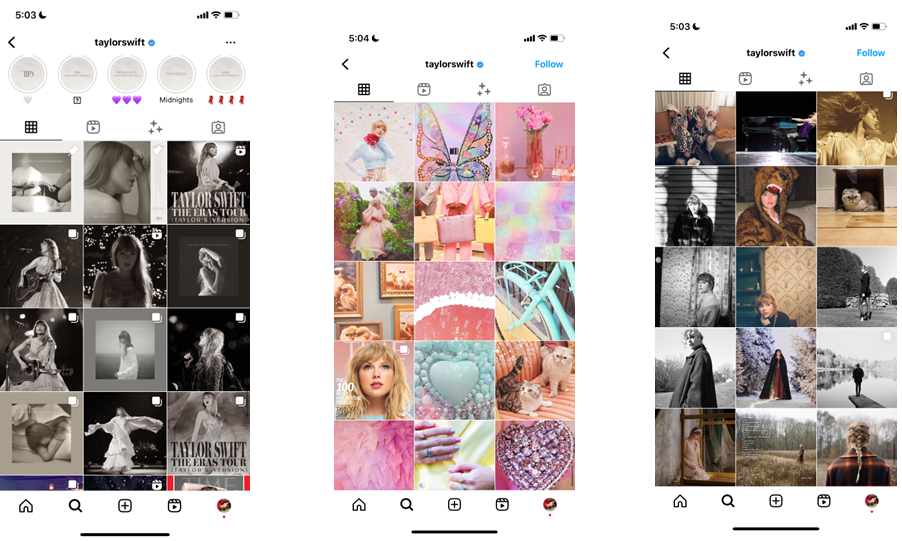
The most notable of Swift’s rebrands on social media was when she went dark prior to her
“Reputation era.” This was during the Kim/Kanye drama of 2016, when the pop princess faced internet backlash for approving/not approving of an explicit lyric about her in one of Kanye’s songs. In the wake of the backlash, she went off the grid. Swift erased her social media presence, eventually coming out of the woodwork with cryptic, darkly coloured posts of a snake – leading up to the release of her Reputation album, of course.
“She’s created brands within herself that she can market with merch,” Green-Rhoades said, noting how the song “Cardigan” inspired cardigans being sold on Swift’s website (Swift even turned the one-off merch into a line, creating new cardigans for consecutive albums). Each of Swift’s eras is a brand: Lover is sweet, soft and pink, Reputation is dark, edgy and vengeful, 1989 is bright and blue-toned, etc. Swift’s costuming during the performances of the songs from these eras on her tour – and the merch to accompany each era – embodies the era’s particular aesthetic.
This is era-based branding in its purest form: each album functions like a sub-brand with its own colour palette, typography, costumes, merch and emotional lane. Taken together, they form a flexible personal branding strategy – one that lets Swift reinvent without ever feeling like a completely different person. The language shifts with each era too, from lyrics to captions, which is part of why the whole thing still feels human instead of corporate.
“‘Which era are you?’” Brodesser-Akner recalls a Swiftie asking her at an Eras tour show. “‘The era isn’t the album you like,’” the Swiftie clarified, “‘it’s the one you are.’”
The Era of the postmedia celebrity
Swift has harnessed the power of her personal branding at her shows, working with her fans to draw attention to her new music (no New York Times reporter required).
On tour, Swift is aware that all eyes are on her – fans livestream the shows, “so everyone knows something the second she announces it [on tour],” Green-Rhoades explained, adding that “it could be 3 am here and she could be doing a show in Japan,” but if she announces something people will know about it instantly.
For example, when Swift announced the 1989 re-release (Taylor’s Version) at a show, it went viral instantly, thanks to fans posting about the calculated “surprise” on Instagram (air quotes because, in her documentary on Netflix, Swift said that her life is planned out “two years in advance”).
Swift uses this to her advantage – she has (most likely) assembled a strong marketing team to execute her creative vision, but it’s the Swifties who bolster her self-promotion – all she has to do is sing.
It’s a perfect example of how postmedia celebrities use platforms like TikTok and Instagram as both stage and press tour, letting fans do the work of distribution in real time. That setup is exactly why any conversation about a potential TikTok sale or ban feels so high-stakes for artists and creators. The same parasocial relay – audience obsession → free promo → billion-dollar outcomes – is at play in viral interview formats and influencer “dates” too.
The Legacy of Era-Based Branding
You might not be Taylor Swift, but if you’re a growing brand looking to upscale your marketing strategies, you need a strong marketing team (no Swiftie loyalty required). That’s where we come in: from increasing brand awareness to generating leads and driving sales, our team at Arnold Street Agency is here to help you reach your goals and elevate your business.
As a digital marketing agency in Toronto and creative agency, we help brands borrow the best parts of Taylor Swift’s marketing strategy – clear eras, strong visuals, fan-first storytelling – and translate them into campaigns that actually make sense for your world. Questions? Visit our digital marketing services to learn more and get in touch with us.